Wednesday, February 3, 2010

The Transition

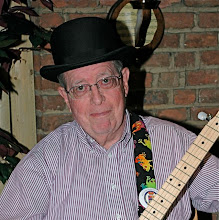
I haven't published much on this blog, because, frankly, I got tired of thinking of legal related topics to write about. I am now retired and, except for a few wills and estates for family and close friends, I think it would be ducky to retire from the law as well. I know that some colleagues love the law and would continue to practice to their dying day. I like the law, find it fascinating, but also find it getting more and more complicated. So, since I have told my banjo buddies that my musical name should be Barrister Bill, I will use this blog to write primarily about my musical progress, mostly on the banjo, but also on the mandolin or any other acoustic instrument I might try. I am not going to even think about giving instructions. There are others who are much better at that than I. One in particular is Patrick Costello.

So, this will become, in effect, a diary of my progress and, hopefully, spur me on practice righteously. I do know that I must sing as I'm playing. In fact, I should first of all learn to sing the songs. The songs that I can play thus far, not really well, but I can recognize them are:

1.)  Michael Rowed the Boat Ashore
2.)  Skip to My Lou
3.)  Red River Valley
4.)  Bile Them Cabbage Down
5.)  Cripple Creek
6.)  Wildwood Flower
7.)  Gypsy Girl

I am currently working on Rosin the Beau and Spanish Fandango. So, we'll see how all of this goes.  

Tuesday, May 5, 2009

MOHS Surgery

I had MOHS surgery on my left cheek today to remove bad little cells that had taken up residence there. I was at the dermatologist's office for about an hour and fifteen minutes. I think the surgery took about twenty minutes. They called later to say that they had gotten the deep cells but that there were some peripheral cells that still remain that they can freeze dry in about four weeks. I will get my stitches removed next Tuesday. All in all the procedure wasn't bad - there really was no pain except the small sting of the needles when I got numbed - and the healing pain isn't very much either, yet. The last time I had it, it wasn't bad either. Tylenol will take care of it, if necessary. 

Folk Musicians' Retreat

I recently attended a Folk Musicians' Retreat at Janes Island State Park in Crisfield, MD, organized by Pat and Patrick Costello. It was a bold excursion for me because even though I am trying to learn to play the banjo, I felt that I was not far enough along to be considered a "musician." Well, I was pleasantly surprised by the nice group of people that I met there who were willing to share and to help me learn. The weekend, from Thursday to Sunday morning, was fairly unstructured, which worked out surprisingly well. There were some specific workshops, but for the most part, you could just sit where others were gathered and you would learn something. Some of the people there have been playing individually or in bands for years and were very good players. Others were about where I was/am, so I didn't feel uncomfortable. There is a very great deal to learn and I am just beginning the journey, which is why there is no video posted of me playing the banjo. Go to www.tangiersound.wordpress.com and scroll down for pictures of the Retreat.

Saturday, February 7, 2009

Tweet, Tweet & Blogalong

Barrister Bill thinks there is too much of this social networking stuff going on. There are blogs, space books, face pages and Twitter, to name but a very few. These sites are said to be useful to find people, but we know people that don't use their correct name and even have friends that misspelled their own name, whether by accident or on purpose, we don't know, but how will anyone find them? There are also endless sites on which to store and share pictures. She Who Must be Obeyed has posted pictures somewhere on Picasa, but isn't quite sure how to see them and steadfastly refuses to use the backup hard drive with which she was generously supplied, so what is the point of it all. By the way, I must digress to explain that since we are on a legal (sort of) blog, some legal terminology will be used. "She Who Must be Obeyed" is a term secretly used by Horace Rumpose, the title character in John Mortimer, QC's series Rumpole of the Bailey, to refer to his long suffering wife, Hilda.

Back to the topic. It all reminds me of the days of the CB radios. For those of you under a certain age, "CB" stands for Citizens Band and such radios were all the rage in trucks and then cars a number of years back as citizen drivers trolled along the highways with incessant, mindless, chatter about nothing in particular. "Breaker, breaker, 1 - 9." Increasingly sophisticated radios were developed and installed. We had one too and then a better model. All to say what? All of us thought that we were pretty hot stuff. We could all communicate with one another, as long as we weren't more than about five miles apart. Eventually, car phones began to replace CB radios or people just lost interest in them. Nowadays, each of us has a cell phone, except Barrister Bill, and there are more ways to share mindless information than ever.

She Who Must be Obeyed showed me a video on Twitter explaining how it all works and the announcer did say that maybe everyone would not be interested in what you do all day (Ya think!), but for those who are interested, you can Tweet, but you can only use 140 characters or something like that.

BARRISTER BILL TO THE RESCUE - I have come up with a better way. It's called Tlogging. It's very simple and it will save everyone a lot of time. You just Tweet on your blog. That way, you have more control over who sees it and you aren't limited to 140 characters. My goodness, a lawyer can't even clear his or her throat in 140 characters. I'll give you a few examples of how it works. This is a blog, so now I will Tweet to tell some of what I did today.

TWEET: I had my car serviced today. No major problems. Score one for me.

TWEET: We went for a walk.  

TWEET: I started refurbishing some old sleds. There is a Flexible Flyer and one made by Paris Mfg. Co, So. Paris, Me. Sled makers since 1861.

TWEET: She Who Must be Obeyed decided to give me a cooking lesson. I had to decide if we should mix the gravy with the pork and potatoes in the pan or serve the gravy separately. I decided to pour it in the pan. She also assigned me to help make cauliflower with a melted cheddar cheese sauce on it, which I did. Her recipe was to melt the cheese in a pan and to then pour it over the cauliflower after it had been micro-waved for two minutes. It came out fine, but I have a better recipe. I observed carefully the method used and came up with the following: 1.) I cut the cauliflower in pieces, then I took one and ate it. 2.) I cut a piece of the cheese. I ate it too. All of the process taking place in the microwave and stove happened in my stomach. I saved electricity and didn't need to get a pan or bowl dirty. The end result was pretty much the same. As I enter my retirement years, when helping in the kitchen, I will share more of these recipes with Anne. I'm sure she will be happy to have these helpful hints to more efficient meal preparation.

So there you have it. I bet people don't Tweet recipes too often, but you can see that with Tlogging, there is nothing to it. 

Barrister Bill does not intend to Twitter, have a space or face page and to any twit out there who feels a need to know more about what I do all day, I say, get a life.

Friday, February 29, 2008

THE PERILS OF DEFECTIVE REAL ESTATE DOCUMENTS


There are many reasons why a real estate document may be defective. Some are obvious: lack of signatures, lack of or defective acknowledgement, failure to include a description sufficient to identify the property, wrong or misspelled names of the parties, etc. Some are not so obvious. There is, of course, what seems to be the never ending question of who must sign a mortgage. The simple answer is that whoever is in title (named on the deed, owns the property) must sign the mortgage. But, as we all know, things are rarely simple.


I have a friend, Ray, who is retired and isn’t doing anything much these days, so let’s put him to work for us on these problems. Ray has a lovely wife whose name is Betty. Suppose Ray and Betty buy a house and they want to finance part of the purchase price. First, they will need to make sure that they get a deed correctly naming them as the purchasers. They will then own the property as tenants by the entirety (because they are married). If one of them should die, the other one automatically becomes the owner of the real property without the need to record another deed. Now, as they are financing the purchase of their new home, they will need to sign a note promising to repay the money that they borrowed from the bank. They will also be asked to secure their promise to repay the loan by signing a mortgage to the bank, which will then be recorded and becomes a lien on their property until it is cancelled or discharged of record.


Suppose the deed names both Ray and Betty as the new owners, but only Ray signs the mortgage. The mortgage is defective because it does not protect the bank if there is a default and it wants to foreclose. The bank would not be able to foreclose on Betty’s interest because she didn’t sign and therefore did not give her consent. Maybe Betty signed the note. In that case, the bank could sue Betty on her promise to repay, but it couldn’t foreclose her interest in the real estate.


What happens if Ray bought the house in his name alone and a few years later decides he wants to get a loan to put on a new addition for his model railroad? Betty will need to sign a mortgage for this transaction because she is living in the house as the marital home. Ray may find it difficult to continue living in the house if he is intent on spending all of that money on his trains.


But, let us add some complications to these simple situations. Suppose that Betty signs the mortgage, in either case, but her name does not appear on the first page where the borrowers are named. The mortgage is defective. Suppose that both Ray and Betty sign the mortgage and their names appear in all the right places, a notary signs and seals everything nice and clear and the mortgage gets recorded, except, Betty didn’t actually appear before the notary. The mortgage is defective.


Some of these things may seem like inconveniences that can be fixed and they can be fixed. However, there is something called Bankruptcy lurking in the forest. The Bankruptcy Act is a federal law designed to help debtors get out of monetary distress and to reestablish their financial lives. A Trustee in Bankruptcy is someone appointed to take control of the debtor’s assets and to fairly use those assets to pay off the debts. The Bankruptcy Code gives great powers (called the “strong arm” provisions) to a trustee to “avoid” certain debts, including defective mortgages. The trustee is deemed to lack notice of a properly recorded, but defective mortgage. This can become a very big problem if the borrower files for bankruptcy protection, or if a creditor forces the borrower into bankruptcy. As far as the bankrupt estate is concerned, the mortgage does not exist and the lender will have to stand in line with the rest of the unsecured creditors. He will be very unhappy and, while standing there in line, will surely be reviewing his title insurance policy.


Another area in which a trustee may attack the interest transferred by a document is in the timeliness of its recording. Generally, a document must be recorded or filed within ten days of the creation of the interest that it secures or conveys.


This is only a very brief synopsis of the many, many reasons that a document can be attacked, or, that it does not convey the interest intended. Title insurance underwriters, of course, can get stung paying claims or litigating matters involving defective documents. Language in title policies has been revised time and again to tweak protection or to accede to lender’s objections that coverage should be more liberal. Title insurance producers can help to protect underwriters and clients, as well, by taking the time necessary to carefully review documents and to follow correct procedures for signing and recording. The writer would like to thank Ray and Betty for their valuable contribution to this article. 

Wednesday, February 20, 2008

This blog is under construction - Stay tuned